
Operational Excellence in Manufacturing Plants: 2026 Guide
Table of Contents
- What Operational Excellence in Manufacturing Plants Actually Means
- The Five Pillars of Operational Excellence and the 80/20 Rule
- Manufacturing KPIs for Operational Excellence That Drive Real Decisions
- Your Operational Excellence Implementation Plan: A 12-Month Sequence
- Continuous Improvement Strategies: Lean, Six Sigma, and Kaizen in Practice
- Change Management Psychology: Why Plant Floor Execution Stalls
- Sustaining Results: Post-Implementation Maintenance and SME Scaling
- Frequently Asked Questions
Last Updated: September 16, 2026
What Operational Excellence in Manufacturing Plants Actually Means
Operational excellence in manufacturing plants is the disciplined practice of aligning people, processes, and technology so every shift produces predictable, measurable results against a defined standard. At ProAction, we've spent over 30 years helping mid-market manufacturers close the distance between strategic intent and what happens on the floor.
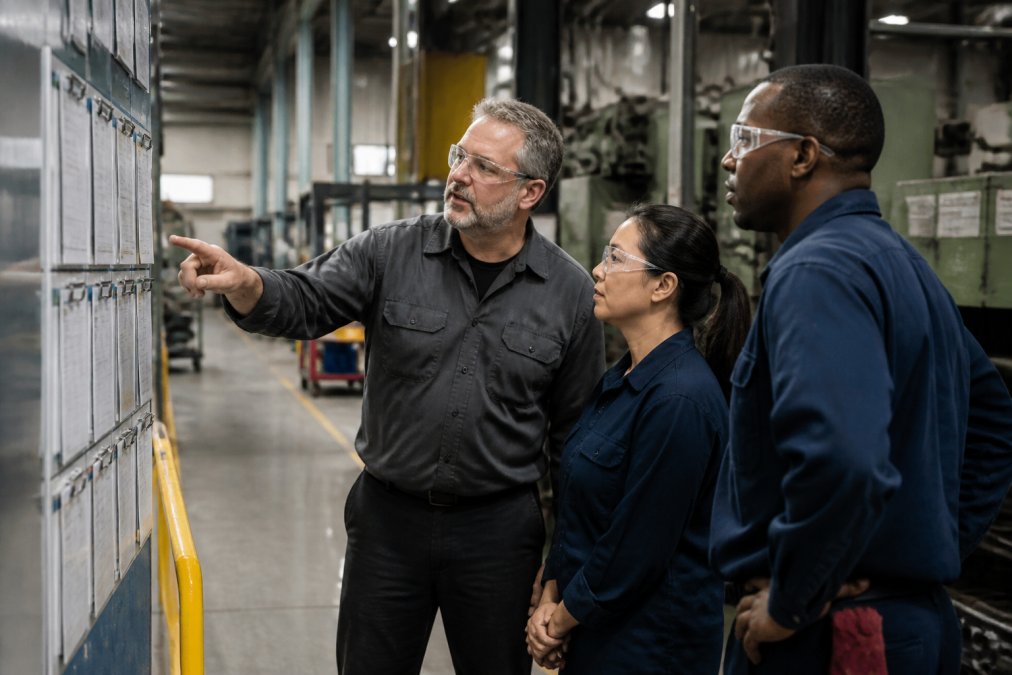
The gap is rarely technical. It's a coordination problem.
Most plants already own the machinery, the ERP system, and the dashboards.
The Five Pillars of Operational Excellence and the 80/20 Rule
Five pillars carry the weight: leadership discipline, standardized work, continuous improvement, data-driven decision making, and workforce engagement.
Manufacturing KPIs for Operational Excellence That Drive Real Decisions
Manufacturing KPIs for operational excellence are the small set of measures that tell a plant whether it's winning or losing today, not last quarter.
Leading vs. Lagging: The Distinction That Makes a Scoreboard Useful
Lagging indicators report outcomes you can no longer influence: monthly scrap cost, quarterly on-time delivery, annual cost per unit.
The KPIs That Belong on a Plant Floor Scoreboard
| KPI | Type | What It Reveals | Review Cadence | Typical Owner |
|---|---|---|---|---|
| Overall Equipment Effectiveness (OEE) | Lagging | Asset use and hidden losses | Daily | Production manager |
| Cycle time | Lagging | Throughput against takt | Per shift | Line supervisor |
| First-pass yield | Lagging | Quality control at the source | Daily | Quality lead |
| Unplanned downtime | Lagging | Predictive maintenance gaps | Daily | Maintenance lead |
| Schedule attainment | Lagging | Planning accuracy and supply chain resilience | Weekly | Operations director |
| Standard work audit completion | Leading | Whether the documented method is actually followed | Weekly | Line supervisor |
| Andon response time | Leading | Whether problems surface and get help fast | Per shift | Shift lead |
| Improvement actions closed on time | Leading | Whether the improvement habit is real or theater | Weekly | CI coordinator |
Setting Targets Without Gaming the Number
The Metric Review Rhythm
Numbers on a board don't improve anything by themselves.
Your Operational Excellence Implementation Plan: A 12-Month Sequence
An operational excellence implementation plan works when it sequences change in the order the organization can absorb it.
Phase 1: Baseline and Diagnose (Months 1-3)
Measure before you change anything.
Phase 2: Redesign and Standardize (Months 4-6)
Redesign the work around the constraints you found.
Phase 3: Scale and Sustain (Months 7-12)
Extend the model to additional lines or plants only after the first area holds its gains for two consecutive months.
Continuous Improvement Strategies: Lean, Six Sigma, and Kaizen in Practice
Continuous improvement strategies only work when the method matches the problem.
Choosing the Method by the Symptom
| Symptom You See | Method That Fits | Why |
|---|---|---|
| Material waits between stations | Value stream mapping and lean flow | Exposes where work stalls and where WIP hides |
| Same defect keeps returning | Root cause analysis (Six Sigma) | Drives to variation source, not the symptom |
| Unplanned downtime dominates losses | Total productive maintenance | Shifts from reactive repair to planned reliability |
| Operators won't engage with improvement | Kaizen events | Small, fast wins build buy-in and habit |
| Process is stable but slow | Cycle time reduction and standard work | Removes non-value steps without destabilizing |
The Cadence Is the Strategy
- Daily: shift huddles surface problems and assign owners within the shift
- Weekly: a focused improvement session tackles one constraint or one recurring defect
- Monthly: a review of the improvement backlog, closure rates, and whether the gains are holding
- Quarterly: a value stream review to confirm the constraint hasn't moved
Governance: Who Owns Improvement
Improvement without ownership decays.
Measuring Improvement Velocity, Not Just Results
The Post-Event Trap
Most guides stop at "run the event." The harder discipline is the 90 days after: standard work updated, training refreshed, and the new method audited until it becomes the default.
Change Management Psychology: Why Plant Floor Execution Stalls
This is where ProAction's Coordination Gap Model does its work: it treats execution as a series of human promises, making each commitment explicit and each owner visible. Culture becomes something you can measure through kept and broken commitments.
Sustaining Results: Post-Implementation Maintenance and SME Scaling
Post-implementation maintenance also means periodic re-baselining. A standard written for last year's product mix quietly becomes wrong. Review it annually, or when the mix shifts materially.
Frequently Asked Questions
What is operational excellence in manufacturing?
Operational excellence is how a plant consistently turns strategy into measurable results on the floor: stable processes, clear ownership, and daily decisions tied to data. It is not a certification or a software purchase. It shows up as lower cycle time, fewer defects, higher overall equipment effectiveness (OEE), and predictable production throughput. Plants that practice it treat execution as a series of human promises, not a stack of reports, and they measure the gap between what leadership intends and what actually happens each shift.
What are the five pillars of operational excellence?
Most frameworks settle on five: leadership and strategic alignment, workforce engagement, process optimization, data-driven decision making, and continuous improvement. The pillars only work together. A plant with strong lean manufacturing techniques but weak leadership alignment will plateau within a year. A plant with engaged teams but no KPIs will drift. When you assess your own operation, score each pillar honestly and fix the weakest one first, because that is usually where the coordination gap widens.
What are the most important manufacturing KPIs for operational excellence?
Start with overall equipment effectiveness (OEE), cycle time, first-pass yield, scrap and rework rate, on-time delivery, and asset utilization. Add safety incidents and unplanned downtime as leading indicators. The mistake most plants make is tracking 40 metrics and acting on none. Pick six to eight that map to your strategic goals, review them at a daily standup, and assign one owner per metric. A scoreboard nobody owns becomes wallpaper within a month.
How long does an operational excellence implementation plan take?
A realistic sequence runs 12 months: roughly three months to baseline and diagnose, three months to redesign and standardize processes, and six months to scale and sustain. You should see early wins, such as reduced downtime or faster changeovers, inside the first 90 days. Full cultural adoption takes longer, often 18 to 24 months. Anyone promising transformation in six weeks is selling a workshop, not a system. Budget for the maintenance phase too, since gains erode without it.
How does operational excellence impact EBITDA?
Operational excellence moves EBITDA through three levers: waste reduction, throughput gains, and asset utilization. Cutting scrap and rework lowers direct material and labor cost. Raising OEE and production throughput lets you sell more from the same equipment. Better cycle time frees working capital tied up in inventory. For middle-market manufacturers, these levers compound, which is why private equity partners push for operational efficiency before an exit. The gains only hold if root cause analysis and standard operating procedures keep them in place.
How do you bridge the gap between strategic intent and plant floor execution?
The gap is rarely a strategy problem. It is a coordination problem. Leadership sets goals, but nobody converts them into specific promises with named owners, deadlines, and follow-up. Bridge it by translating each strategic goal into two or three floor-level actions, assigning a single owner per action, and reviewing progress in short daily huddles instead of weekly status meetings. When execution is treated as a series of human promises, ownership gaps close and meeting fatigue drops at the same time.
What role does leadership development play in operational excellence?
Supervisors and shift leads determine whether new standards survive contact with a busy shift. If they cannot coach, give feedback, or run a five-minute huddle, tools and dashboards will not help. Leadership development in this context means teaching managers to set clear expectations, follow up on commitments, and use data in conversations without blame. Plants that invest here see continuous improvement strategies stick; plants that skip it watch gains fade after the consultants leave.
Can small and mid-sized manufacturers run an operational excellence program?
Yes, and they often see results faster because decisions do not travel through layers of management. Start with one production line rather than the whole plant. Use value stream mapping to find the biggest bottleneck, apply kaizen events to fix it, and standardize what worked before moving on. Avoid copying a large manufacturer's program wholesale; scale the scope to your headcount. A 120-person plant can run a full improvement cycle with existing staff if priorities are clear.